Working alongside the government system
NGOs working in education reform efforts often face a fundamental choice: should external programs try to replace struggling systems, or should they work to strengthen what already exists? The Vinoba program takes a clear stance on this question by deliberately choosing not to bypass existing structures. Rather than operating parallel schools, after-school programs, or separate training initiatives, Vinoba focuses on improving the government education system itself. We do so by using technology and behavioural science tools.
The Vinoba program is also uniquely positioned to install new technology within government systems. As an independent actor, Vinoba:
- Takes the risk out of building technology for government schools: There are no competitive private schools that can come remotely close to the size and geographic spread of government schools. As a result, the general system of private-sector technology development for later adoption by the public sector is not possible in the education sector. Additionally, technological changes are rapid, and most software projects fail. Constructing software that works for government administrators and school teachers in remote rural areas is a unique challenge. Vinoba bridges this gap and ensures the timely, practical development of technology through multiple short, rapid cycles of customer rollout, bug fixes, and improvements.
- Provides expertise: Software development for large organisations and multiple users requires sophisticated product engineering that incorporates flexibility, simplicity, usability, performance, security, and timely maintenance. Vinoba provides this detailed understanding of technology with our dedicated team of experts.
- Facilitates Program implementation: The Vinoba program focuses on ensuring end-to-end coordination, with a focus on ground-level execution. One of the biggest challenges of the public education system is the lack of staffing. This constraint makes even the smallest decisions, such as teacher recognition or staff reallocation, take a long time to execute. Vinoba’s flexibility and quick turnaround ensure that the ground-level execution of programs, which require multiple small decisions to adapt to local realities, proceeds smoothly.
- Provides long-term continuity: Most IAS officers have a tenure of 2-3 years in a single district. Developing new education programs and testing software like Vinoba takes a long time. Vinoba provides this long-term vision and continuity by working closely with all IAS officers after implementation in a district and continuing beyond the singular terms of IAS officers.
Therefore, the Vinoba program makes the existing system more efficient by empowering teachers, assisting district administrators, and working with the state to ensure positive developments in education policy.
A digital companion for teachers and administrators
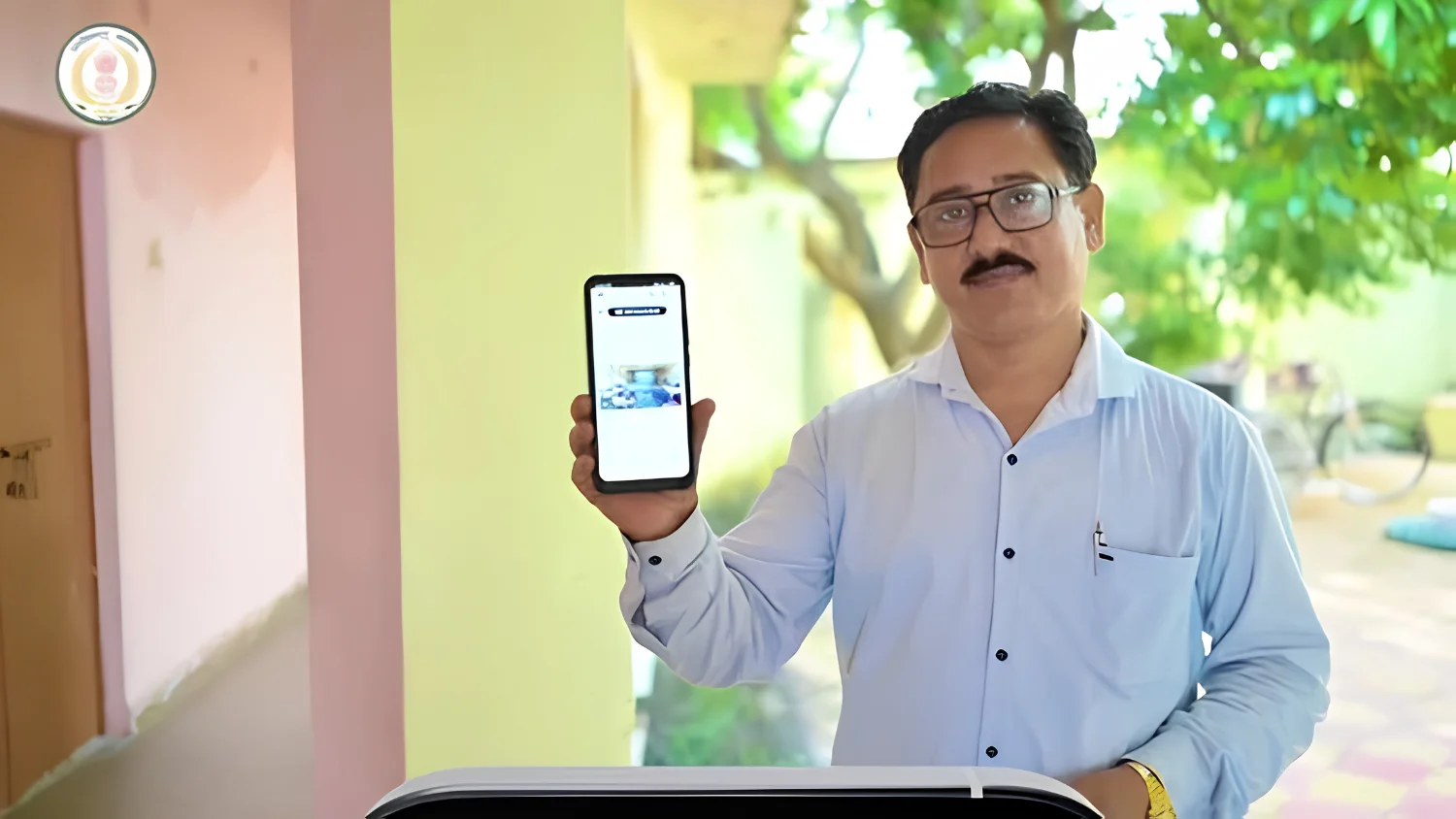
Vinoba provides teachers with immediate access to information, activities, and learning materials. Whether preparing a lesson on a challenging topic or seeking activities to engage students in life skills development, teachers can find the materials they need on Vinoba within moments. It enables connection with their peers across schools and districts. Teachers can learn from each other’s experiences, ask questions, and

share solutions to common challenges. This peer network transforms isolated practitioners into members of a vibrant professional community. Teachers freely share their work on the platform, showcasing their students’ talents and achievements. A creative approach to teaching can spread organically through the platform. This creates a network that teachers can rely on for emotional value and teaching solutions.
The app also allows teachers to reach district officials without navigating bureaucratic barriers. When teachers have questions, concerns, or ideas, they can communicate directly with stakeholders who can act on that feedback.
Self-Monitoring and Growth
The app provides teachers with tools to monitor their own processes and progress alongside their students’ academic development. Teachers can see how their activity and performance compare with colleagues across the district. When a teacher sees others successfully implementing a particular strategy, they can use the platform and posts to learn how.
Importantly, the platform recognises the best performance, not just effort. This focus on results helps the system identify and celebrate teaching approaches that genuinely improve student learning.
Vinoba also saves teachers’ time by reducing repetitive, mundane tasks such as duplicate data entry and unnecessary form-filling. Every minute saved on administrative work is a minute that can be redirected toward instruction and student support.
Empowering Cluster Leadership
Vinoba provides cluster heads with extensive area-wide monitoring capabilities. They can closely track school activities, teacher performance, and even student progress across all schools under their supervision. This comprehensive view enables targeted support where it’s needed most. Clusters can also compare their progress with other clusters in the district, driving continuous improvement.
Like teachers, cluster heads benefit from reduced administrative burden. The system eliminates time-consuming tasks such as manual data conversion, compilation, and constant coordination for data-collection reminders. Cluster heads can appreciate and recognise teachers and schools based on actual performance data, making recognition more meaningful and fairer. Real-time access to information, posts, and data enables rapid response to emerging issues and quick amplification of successful practices.
Strategic Oversight at Block and District Levels
At the block and district levels, administrators gain similar oversight capabilities across their broader jurisdictions. They can monitor activity at the cluster, school, and student levels while maintaining an overview of system-wide trends.
Blocks can implement programs tailored to their specific needs while collecting data according to local priorities. Districts learn from the best practices emerging in other districts, fostering innovation that spreads across regions.
For IAS officers and senior administrators, Vinoba provides real-time monitoring of data, activity progress, and program performance across the district. This enables faster, more informed decision-making grounded in actual evidence rather than impressions or delayed reports.

The system also reduces program implementation intervals, creating opportunities to increase the frequency of academic programs. For example, shorter exam cycles allow more practice tests, giving students additional opportunities to demonstrate learning and teachers more frequent feedback on effectiveness. State officials gain clear visibility into key performance indicators for central programs like ASER (Annual Status of Education Report), PGI (Performance Grading Index), NAS (National Achievement Survey), and PAT (Periodic Assessment Tests). This comprehensive view allows strategic planning and resource allocation.
Data-driven insights can even inform teacher transfer policies, helping districts rationalise assignments to improve outcomes at the school level. When administrators understand where specific skills and experience are most needed, they can make staffing decisions that benefit students system-wide.
These time savings cascade upward through the system. When teachers, cluster heads, block and district administrators all spend less time on administrative tasks, those collective hours translate into substantially more capacity for classroom intervention and instructional improvement.
Conclusion
The Vinoba approach rests on a foundational belief: government education systems can serve all students well when equipped with the right tools, information, and support structures. Rather than compensating for system gaps through parallel efforts, Vinoba amplifies the system’s own capacity to identify needs, deploy resources, recognise excellence, and continuously improve.